
Commercial Spray Foam Roofing in Arizona: What Owners Should Know Before They Bid
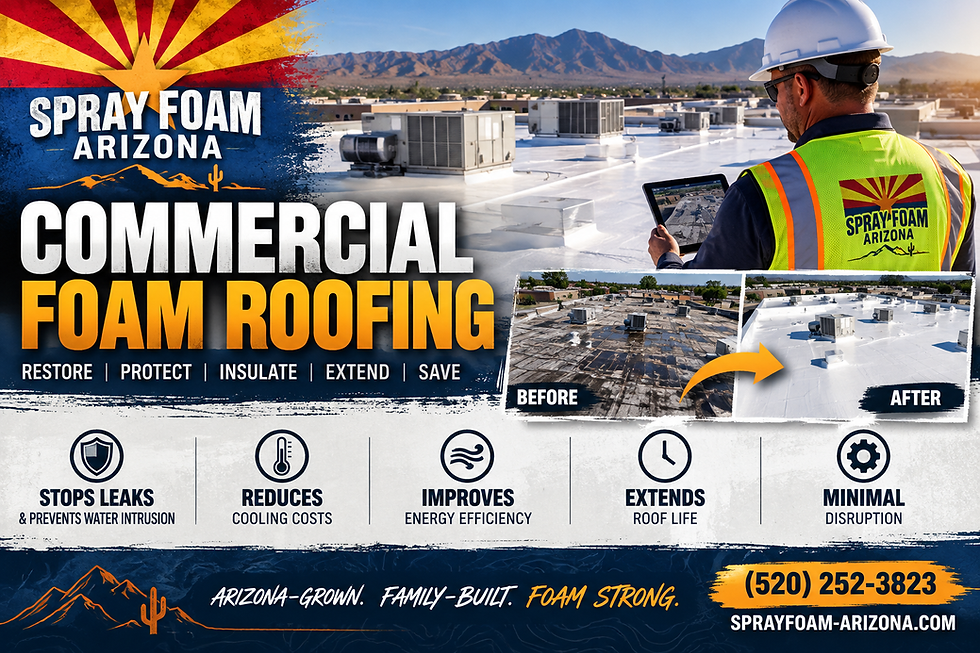
Commercial spray polyurethane foam (SPF) roofing is a field-applied roof system that combines closed-cell foam with a protective coating or other approved covering. It can be a strong option for some low-slope commercial roofs in Arizona, especially when an owner wants to address complex penetrations, improve the roof’s thermal performance, and restore a sound existing assembly. The roof’s condition, drainage, substrate, occupancy, and system specifications determine whether it is the right choice.
Spray Foam Arizona evaluates commercial, industrial, municipal, and institutional roofs across the state. We are Santa Rosa Construction LLC DBA Spray Foam Arizona, an Arizona-licensed KB-1 contractor (ROC #331359) based in Coolidge. This guide explains what to examine before choosing a system or comparing bids.
What is a commercial spray foam roof?
An SPF roofing crew prepares a suitable roof surface, sprays liquid components that react to form rigid closed-cell polyurethane foam, and then applies a compatible protective covering. The foam conforms around curbs, pipes, and other roof details. The coating protects the foam from sunlight, weather, and wear; exposed foam is not a finished roof.
A complete proposal should identify the substrate and preparation, foam product and specified thickness, treatment of penetrations and edges, drainage details, protective coating system and specified dry-film thickness, and the inspection and maintenance requirements. Exact materials and methods must follow the selected manufacturer’s approved system and the project specification.
When does SPF roofing make sense in Arizona?
SPF may be worth evaluating when the existing roof has many details that are difficult to flash, when a qualified designer or contractor can preserve or improve drainage, and when the underlying assembly can be prepared to support the new system. It is also a candidate for owners seeking a roof restoration strategy without automatically removing every existing layer.
That does not mean every roof is eligible for an overlay. Wet insulation, failing decking, poor adhesion, trapped moisture, drainage defects, code requirements, and structural conditions may require repairs or tear-off first. Existing roof type and condition matter more than a general claim that “foam goes over anything.”
Arizona owners should also distinguish the two components of the system: the foam contributes insulation and forms a continuous roof surface; a properly selected and maintained covering protects that foam. Reflective coating may reduce solar heat absorbed at the roof surface, but any building-level energy savings depend on the existing insulation, HVAC, occupancy, and roof design.
What happens during a professional roof evaluation?
For a commercial building, start with a documented site walk. The scope may include:
Roof history and leaks: previous repairs, recurring leak locations, existing warranties, and rooftop work.
Assembly and moisture: roof layers, substrate condition, suspect wet areas, and whether further testing or selective openings are needed.
Drainage: ponding areas, scuppers, drains, slopes, and overflow provisions.
Details: parapets, metal edges, HVAC curbs, solar supports, penetrations, expansion joints, and traffic areas.
Operations: access, overspray protection, neighboring property, air intakes, weather windows, and whether work must be phased around occupants.
Specifications: product compatibility, code and fire requirements, coating selection, warranty terms, and ongoing maintenance.
For large or moisture-sensitive roofs, an infrared survey can help identify areas for further investigation. It is a screening tool, not a substitute for confirming conditions through appropriate follow-up testing.
How is a commercial foam roofing system installed?
The sequence varies by roof and approved system, but it commonly includes removing debris and unsound material, making substrate and drainage repairs, protecting equipment and adjacent property, preparing or priming the surface as specified, applying foam to the required thickness, and installing the protective coating or covering. The crew then documents critical details, coating coverage and thickness, and final punch-list items.
Overspray control matters on occupied commercial sites. A bid should explain how vehicles, neighboring buildings, intakes, rooftop equipment, and people will be protected. Work sequencing and weather conditions also affect installation quality.
How much does commercial spray foam roofing cost in Arizona?
There is no reliable statewide price per square foot that fits every commercial roof. A useful bid depends on roof area and geometry, the existing assembly, wet or damaged material, access and height, foam thickness, coating system, parapet and penetration details, drainage corrections, protection requirements, and warranty scope.
When comparing proposals, ask every bidder to price the same written scope. A low number may exclude tear-off, substrate repair, drain work, coating thickness, or ongoing inspection requirements. Request an itemized base scope and separate prices for repairs that can only be confirmed after investigation.
How long does a foam roof last, and what maintenance is required?
The service life of an SPF roof depends heavily on installation quality, the protective covering, drainage, traffic, weather exposure, and upkeep. It should be inspected on a regular schedule and after significant storms or rooftop trade work. Check for coating wear, exposed foam, damaged details, blocked drains, and punctures. Repair issues promptly and plan for renewal of the protective covering when the selected system and inspection findings call for it.
The Spray Polyurethane Foam Alliance advises twice-yearly inspections and inspections after severe weather. A maintenance plan and clear warranty responsibilities should be part of the buying decision, not an afterthought.
SPF, TPO, or a different restoration system?
No roof type wins every project. SPF can be especially useful where a continuous field-applied system and complex detail work suit the building. A single-ply membrane, another coating system, or a full replacement may be the better choice when existing conditions, traffic, drainage, procurement requirements, or lifecycle economics point that way.
Ask bidders to explain why their system is appropriate for your particular roof, what conditions could change the recommendation, and what is included in the total cost over time. Our comparison of SPF, TPO, and built-up roofing is a useful starting point for those tradeoffs.
Questions to ask a commercial foam roofing contractor
What did you observe about moisture, substrate, and drainage? What remains unverified?
Which foam and coating products are specified, at what thicknesses, and with what documentation?
What repairs, tear-off, priming, flashing, and edge details are included?
How will you prevent overspray and coordinate around HVAC, occupants, and adjacent property?
How will application quality and coating thickness be checked and documented?
Who provides the workmanship and material warranties, and what are their exclusions?
What inspections, cleaning, repairs, and future recoating does the owner need to budget for?
Can you show relevant completed commercial work and the applicable Arizona contractor license?

Frequently asked questions
Can spray foam roofing be installed over an existing commercial roof?
Sometimes. A qualified evaluation must establish that the existing assembly and substrate are suitable, dry enough, sound, and compatible with the proposed system. Local requirements and manufacturer specifications also control the answer.
Is commercial spray foam roofing waterproof?
A properly designed and installed SPF roof system provides weather protection through its foam, details, and protective covering. Performance depends on the complete assembly and its maintenance; no contractor should promise that coating alone will solve hidden moisture or failed decking.
Will a reflective foam roof lower our cooling bill?
A reflective coating can reduce solar heat absorption at the roof surface. Actual utility savings vary with insulation, existing roof conditions, HVAC operation, occupancy, and climate. Ask for project-specific assumptions before relying on a payback claim.
Does a foam roof need recoating?
The protective covering must remain in serviceable condition. Its renewal schedule is based on the coating system, measured condition, exposure, and manufacturer and warranty requirements. Regular inspections help owners plan renewal before foam becomes exposed.
Do you work on schools, warehouses, and municipal buildings?
Spray Foam Arizona evaluates roofing and insulation projects for commercial, industrial, education, municipal, and other institutional facilities statewide. The recommended scope depends on the building and procurement requirements.
Request a commercial roof evaluation
If you manage an Arizona warehouse, school, church, retail building, industrial site, or public facility, send Spray Foam Arizona the address, approximate roof area, current roof type if known, leak history, roof photos, and any plans or prior reports. We can discuss the evaluation needed and whether SPF restoration is a sensible bid option.
Spray Foam Arizona · Santa Rosa Construction LLC DBA Spray Foam Arizona
Arizona ROC #331359 · Coolidge, Arizona · Statewide service
Call or text: 520-252-3823Website: sprayfoam-arizona.com


Comments